RSVP planning
What should you ask on an RSVP?
Enough information to make the plan. Not so much that replying feels like paperwork.
Published August 6, 2026 · 6 minute read
The short answer
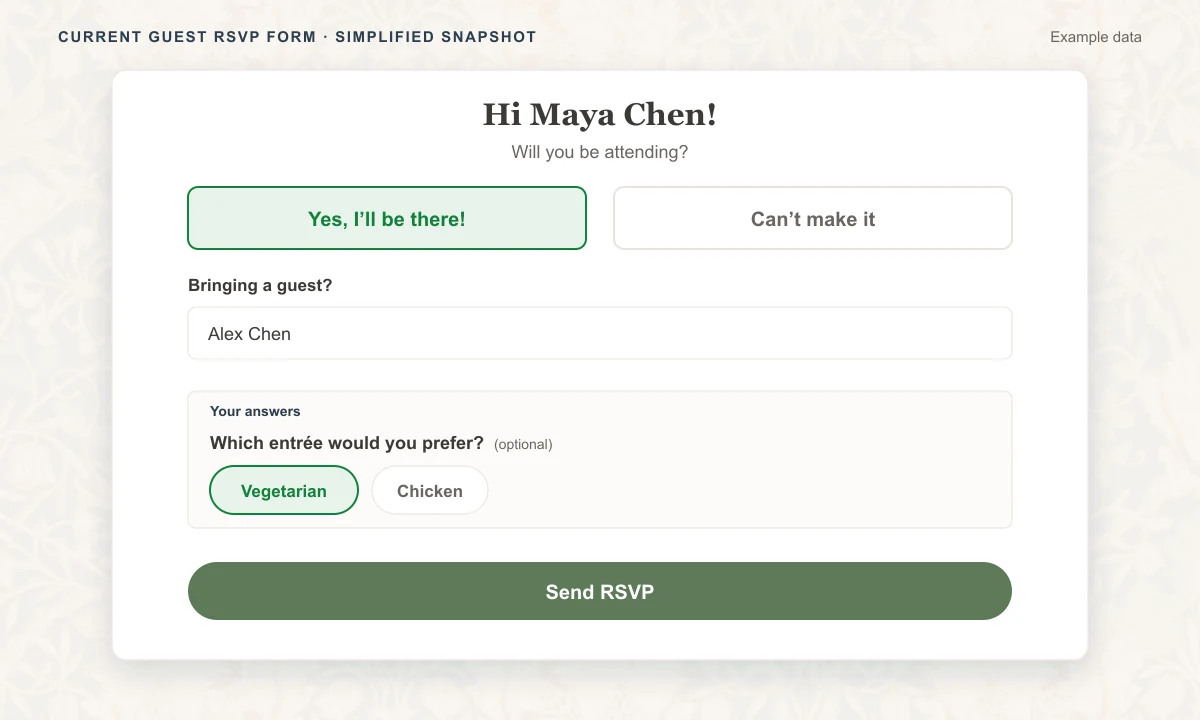
Begin with the headcount: Are you coming, and who from your invitation will be with you? For many casual events, that is nearly the whole form.
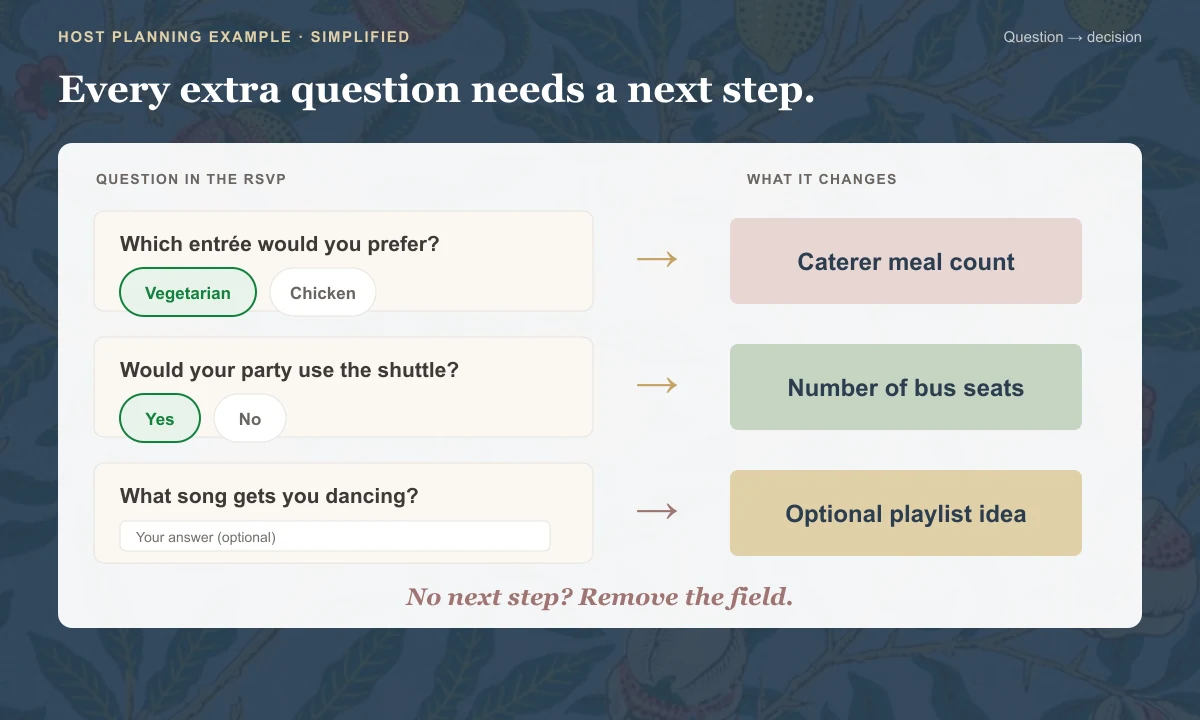
Add another question only when you know what you will do with the answer. Meal choice goes to the caterer. Shuttle use determines the number of seats. An accessibility request starts a direct conversation. A question with no next step is probably clutter.
How forms get out of hand
It starts with one harmless extra question.
A host adds a meal choice. Then a song request. Then an arrival time, a hotel question, a note box, and a required field asking how everyone knows the guest of honour. None of those questions is outrageous on its own. Together, they turn a simple reply into a survey.
The fix is not a magic number of fields. It is a quick edit: for each question, decide who will read the answer and what it will change.
The part every form needs
Settle the headcount first.
Are you coming?
Yes, I’ll be there / I can’t make it
Keep the first choice unmistakable. A guest should not have to read a paragraph before answering it.
Who else is included?
Who from your invitation will attend with you?
Ask for a name or a bounded party size. An open-ended guest count creates more work than it saves.
Before adding another field
Finish this sentence: “I need the answer because…”
“The caterer needs a meal count” is a reason. “I might make a playlist” is a reason to keep the question optional. If you cannot finish the sentence, delete the field. Your guests will not miss it.
When a checkbox is not enough
Some answers should lead to a conversation.
Food allergies and dietary needs
Ask early, then speak directly.
Ask about allergies in the RSVP so the issue comes up early. Food Allergy Canada recommends this, and for good reason: a form response is not a food-safety plan. Speak with the guest and whoever is preparing the food.
“Does anyone in your party have a food allergy or dietary requirement we should discuss?”
Access and participation
Ask what would help.
Ask about accommodation needs in the first notice so you have time to arrange them. The Government of Canada's guide to planning inclusive meetings outlines this approach. You need to know what would help someone participate—not their medical history.
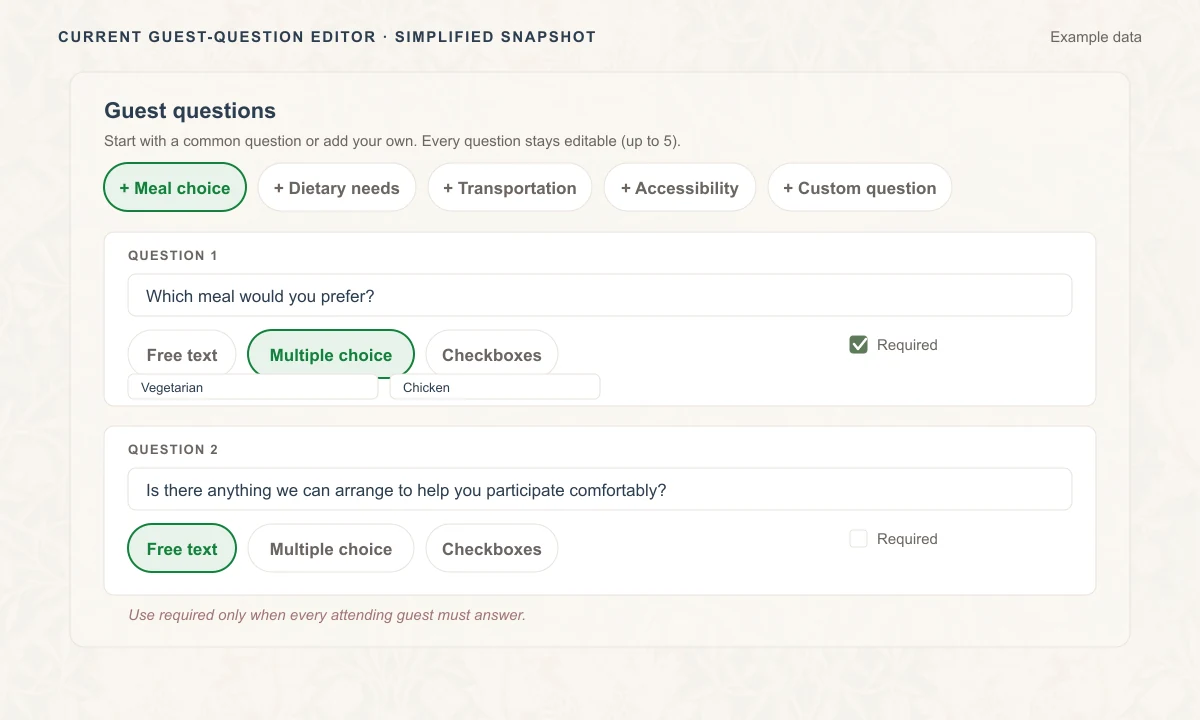
“Is there anything we can arrange to help you participate comfortably?”
Use the asterisk sparingly
“Required” is a high bar.
Require it
Attendance; a meal choice when every attendee must choose; a session selection when capacity depends on it.
Leave it optional
Access arrangements, allergy or dietary details, notes, song requests, and anything that does not apply to every guest.
Show it when relevant
Ask for a plus-one name after the guest says yes. Ask for shuttle details only from people who want a ride.
Copy you can use
Write the question so one answer is enough.
Plus-one
“Will you bring the guest included in your invitation? If yes, what name should we use?”
Household
“Who from your invited household will attend?”
Meal
“Choose one entrée for each person attending.”
Transport
“Would your party use the 5:30 PM shuttle from Union Station?”
There is no universal RSVP form
Three starting points
Dinner or birthday
- Will you attend?
- Will you bring the guest included in your invitation?
- Does anyone in your party have a food allergy or dietary requirement we should discuss?
Catered celebration
- Which invited events will each person attend?
- Which meal option does each attendee prefer?
- Would your party use the scheduled shuttle?
- Is there anything we can arrange to help you participate comfortably?
Workshop or community event
- Will you attend in person or online?
- Which session will you join?
- Do you require an alternative format, captioning, interpretation, or another arrangement?
A quick privacy check
Do not collect details “just in case.”
Collect only what you will use. Your RSVP should follow the same principle the Office of the Privacy Commissioner of Canada recommends for organizations: collect only the personal information needed for an identified purpose, and be honest about why. If a guest might reasonably wonder why you need something, tell them—or do not ask for it.
Usually leave these out
- Information already attached to the invitation
- Medical diagnoses when a practical arrangement is enough
- Full addresses, birth dates, or emergency contacts without a clear need
- Questions whose answers no one will review or act on
- Several required “fun” questions that make responding feel like homework
The five-minute edit
Read the form once as a guest.
- 1.Can I answer the attendance question immediately?
- 2.Does every extra answer change something I will do?
- 3.Can a situational question be optional or conditional?
- 4.Have I explained why I need anything sensitive?
- 5.Will someone actually review every answer?
Sources and context
These sources support the privacy, accessibility, and food-allergy guidance above. The sample questions are starting points. When an answer affects someone's safety or participation, speak with the guest directly—a form response is not a plan.