RSVP planning
When should your RSVP deadline be?
The right date is not a rule of etiquette. It is the date that gives you enough time to turn replies into a reliable final plan.
Published July 23, 2026 · Updated August 6, 2026 · 5 minute read
The short answer
For most local events, set the RSVP deadline two to three weeks before the event. Move it to about four weeks when catering, seating plans, or venue cutoffs depend on firm numbers. Casual gatherings with flexible plans can often use one to two weeks.
For travel-heavy events, work backwards from the earliest accommodation, transportation, or group-booking cutoff. In every case, leave a follow-up buffer—often several days to a week—between the RSVP deadline and the date your final count is due.
A better method than guessing
Work backwards from the final headcount.
Start with the first date when a late change would cost money or create a planning problem. That might be a caterer's final count, a venue capacity decision, seating assignments, transportation, supplies, or your own shopping day.
- 1
Find the real cutoff
Ask the venue or caterer for the final headcount date and whether late additions cost extra.
- 2
Add a follow-up buffer
Move back several days to a week so you can contact people who have not replied and resolve uncertain party sizes.
- 3
Set the RSVP-by date
Use that date consistently on the invitation and in any reminder you send.
Worked example
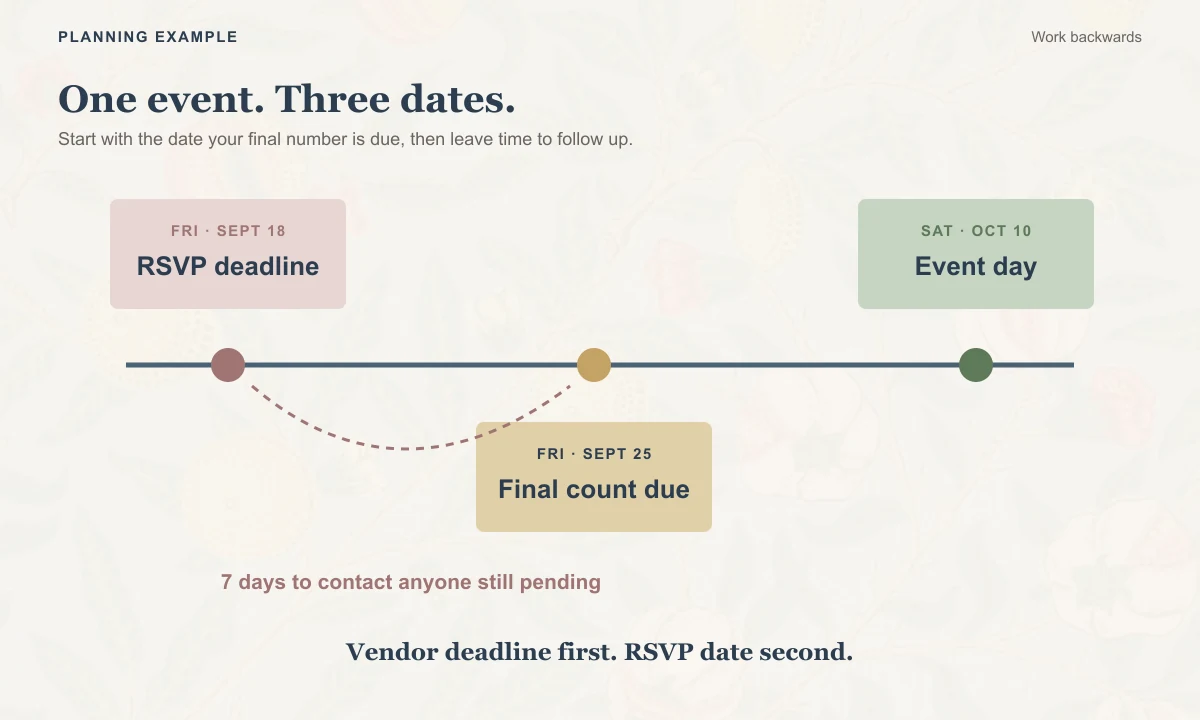
Your event is Saturday, October 10, and your caterer needs final numbers by Friday, September 25. Setting the RSVP deadline for Friday, September 18 leaves one week to contact anyone who has not replied before you submit the count.
This follows Georgia Tech Special Events' practical advice to check when the caterer needs the final headcount before choosing the RSVP deadline. View the planning checklist.
Useful starting points
Suggested timelines by planning complexity
These are planning ranges, not universal rules. Paperless Post suggests one to two weeks for casual events and roughly four weeks when catering or venue availability depends on the count; Eventbrite offers two to three weeks as a general event-planning range.
Casual, local gathering
1–2 weeks before
Usually enough time for food, seating, and a simple follow-up when most guests live nearby.
Standard in-person event
2–3 weeks before
Leaves a practical planning window when there are several moving parts but no unusually early vendor cutoff.
Catered, formal, or seating-dependent event
About 4 weeks before
Creates room to follow up before the caterer, venue, or seating plan needs a final number.
Travel-heavy event
Work backwards from the earliest booking cutoff
Accommodation, transportation, or group-booking deadlines may require responses well before a typical local event.
Sources: Paperless Post's RSVP guidance and Eventbrite's event RSVP guidance.
Move the date earlier when…
- Guests need to arrange travel or accommodation
- Your venue or caterer needs an early final count
- You are assigning seats, transport, rooms, or sessions
- You need details from every person in a group
- Capacity is limited and you may invite a second group
A later date may work when…
- The gathering is casual and most guests are local
- Food and seating can adjust close to the event
- There is no hard capacity or vendor cutoff
- The guest list is small enough for direct follow-up
Make the date easy to act on
What to write on the invitation
Clear beats clever. Put the date near the RSVP action and use the same wording in reminders.
Warm
“Please let us know by September 12—we’d love to celebrate with you.”
Casual
“Can you make it? RSVP by September 12 so we can plan the food.”
Formal
“Kindly reply by September 12, 2026.”
Direct
“RSVP by September 12. Final numbers go to the venue the following week.”
When replies are still missing
What to do before and after the deadline
A few days before
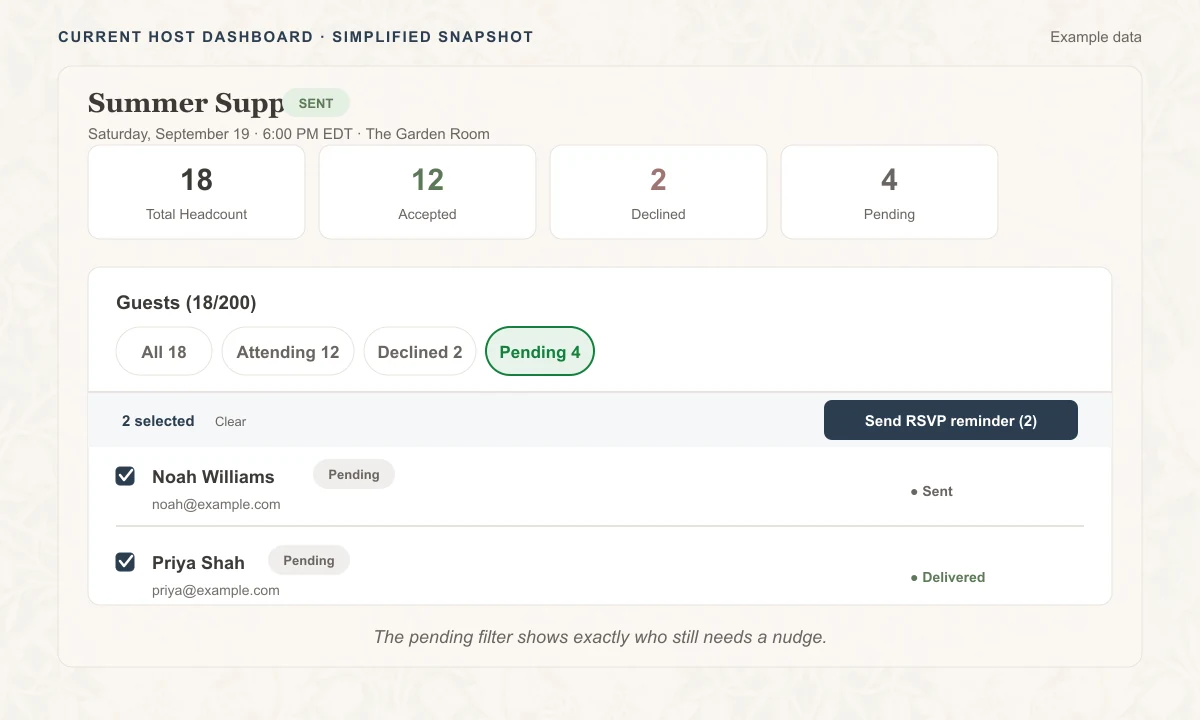
Send one friendly reminder to people who are still pending. Include the event name, deadline, and response link. There is no need to remind guests who already replied.
Once the date passes
Contact the remaining guests directly and give a firm final time. If no reply arrives, explain how you will handle the missing response based on your event's constraints. For a firm venue or catering count, that may mean you can no longer hold their place.
Host checklist
Choose your deadline in five steps
- 1.Confirm the venue or caterer’s final-count date
- 2.List any travel, seating, transport, or capacity constraints
- 3.Leave several days to a week for follow-up
- 4.Write one clear RSVP-by date everywhere
- 5.Plan a reminder for pending guests before the cutoff
Sources and context
These sources are event-planning references and platform guidance, not universal standards. Use them for practical starting ranges, then let signed vendor deadlines, capacity limits, and travel logistics take priority.